Discover
Clarify the outcome, constraints, stakeholders and decision.
Independent proof of concept
From customer discovery to connected cooking.
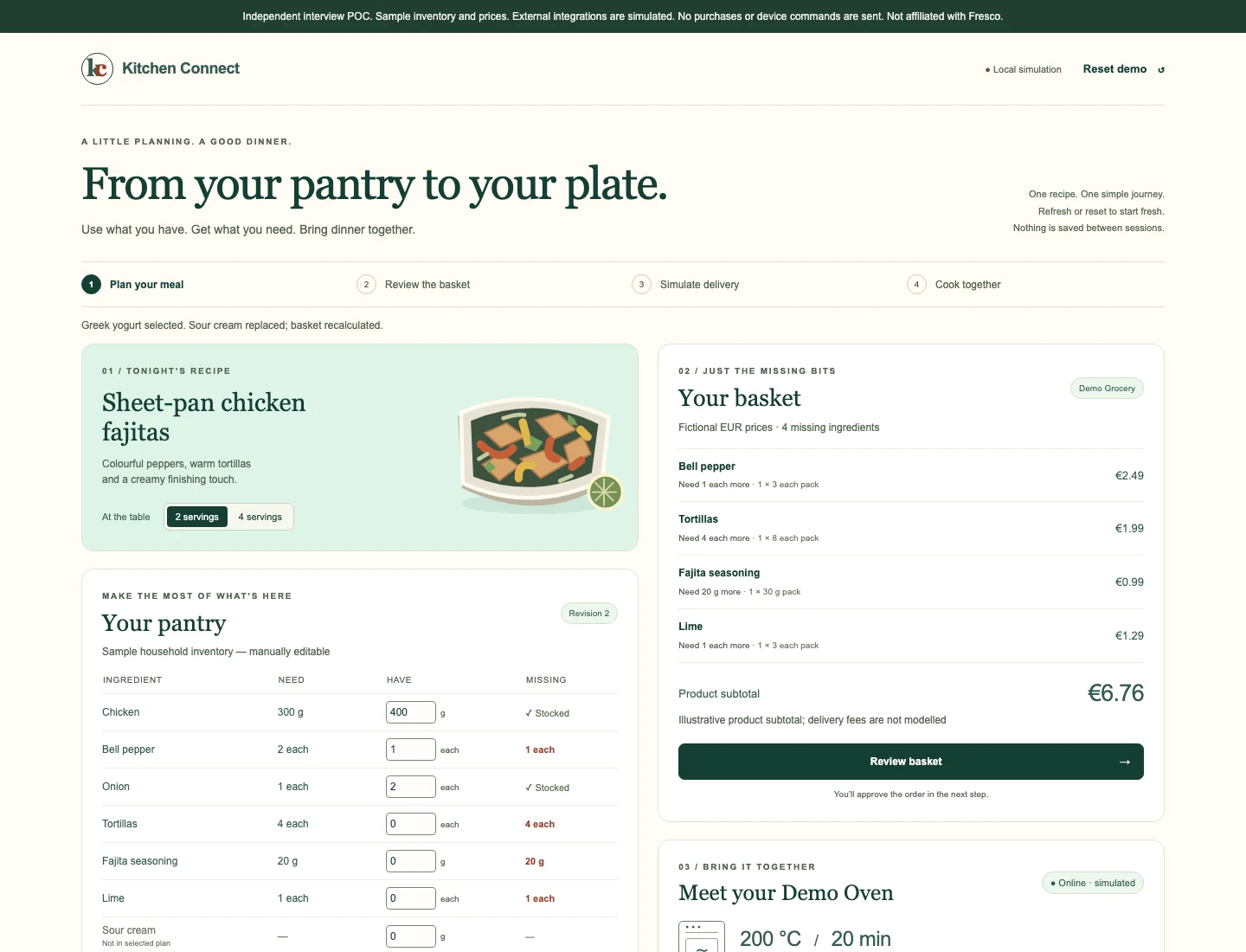
An interactive demonstration of how a meal idea becomes a plan: check the pantry, consider an available substitution, review a grocery basket, and prepare a simulated connected-oven session.
The project brings together customer discovery, architecture choices, a working demonstration, and the questions that must be answered before a real integration.
Sample inventory and prices. Grocery ordering and appliance interactions are simulated. No purchases are placed and no physical devices are controlled.
Try the demonstration
Use Reset demo to return to the starting scenario.
Select the sample fajita meal for two or four people. Inspect the available quantities and the calculated shortages.
Compare the topping option against pantry stock and see how the shopping requirements and basket change.
Approve the basket and place a simulated order. Receiving the delivery is a separate action; ordering alone does not replenish the pantry.
Check readiness and explicitly start the simulated session. Before starting, try the offline or unsupported-program scenario and observe how the plan is preserved.
In Demo controls, choose an Appliance scenario before starting. Use Check oven readiness, then Start simulated cooking when ready. Use Simulate delivery to receive an order.
Why this was built
Discovery, integration boundaries, and visible decisions.
The hypothetical customer brief is an appliance brand exploring a connected-cooking experience that helps households use what they have and fill the ingredient gaps. This is an independent exercise, not a commissioned customer engagement.
The architectural focus is on the handoffs: matching recipe quantities to purchase packs, keeping user approval tied to the current plan, separating orders from deliveries, and checking appliance readiness before an action is allowed.
Clarify the outcome, constraints, stakeholders and decision.
Identify provider, data, device and ownership dependencies before promising an implementation.
Make the journey and selected failure behavior visible, while keeping simulation boundaries explicit.
Presentation
Original discovery & design presentation · v0.2 · 17 slides
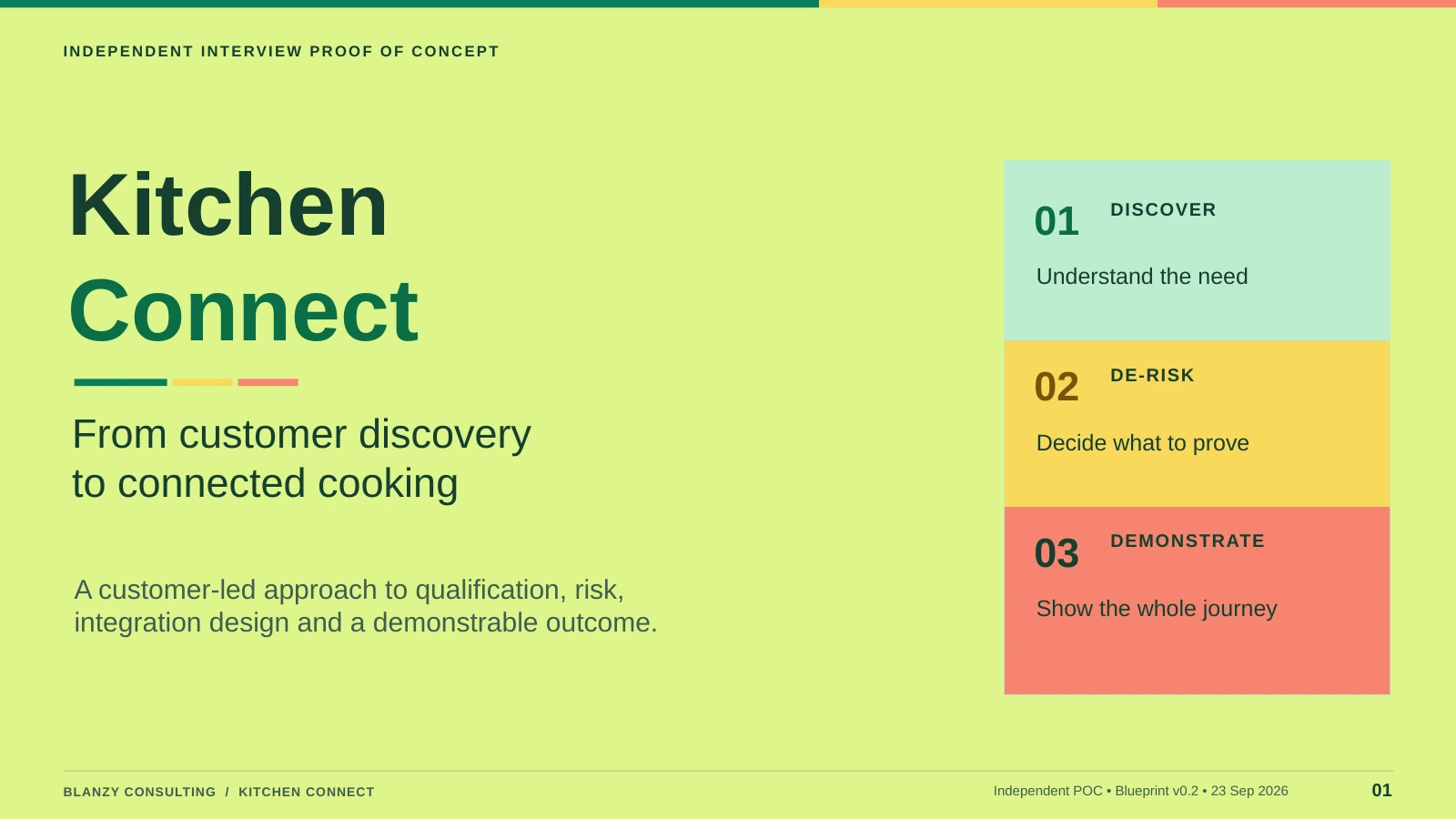
The presentation covers the proposed customer conversation, opportunity qualification, initial risks, integration boundaries, walkthrough, acceptance criteria, and the path from a POC to a live pilot.
Original planning deck, created before implementation. It includes illustrative screens and historical build/test statuses; it is not the current application's release or test report.
PowerPoint includes speaker notes. The PDF contains the visible slides only.
Limits and next step
Independent demonstration. Not affiliated with or connected to Fresco. Not a validated cooking guide.
This POC does not establish access to a retailer or appliance platform, validate physical cooking instructions, or prove production readiness or customer adoption. A live pilot would need authorised provider interfaces, reliable inventory data, device-specific validation, and agreed security, support and safety responsibilities.